While this article does not pertain to the UP, You can read about challenges for OHV riding accros the country as well as about AARA in the link here and below. AARA information visit: AARA
Washington Newsletter
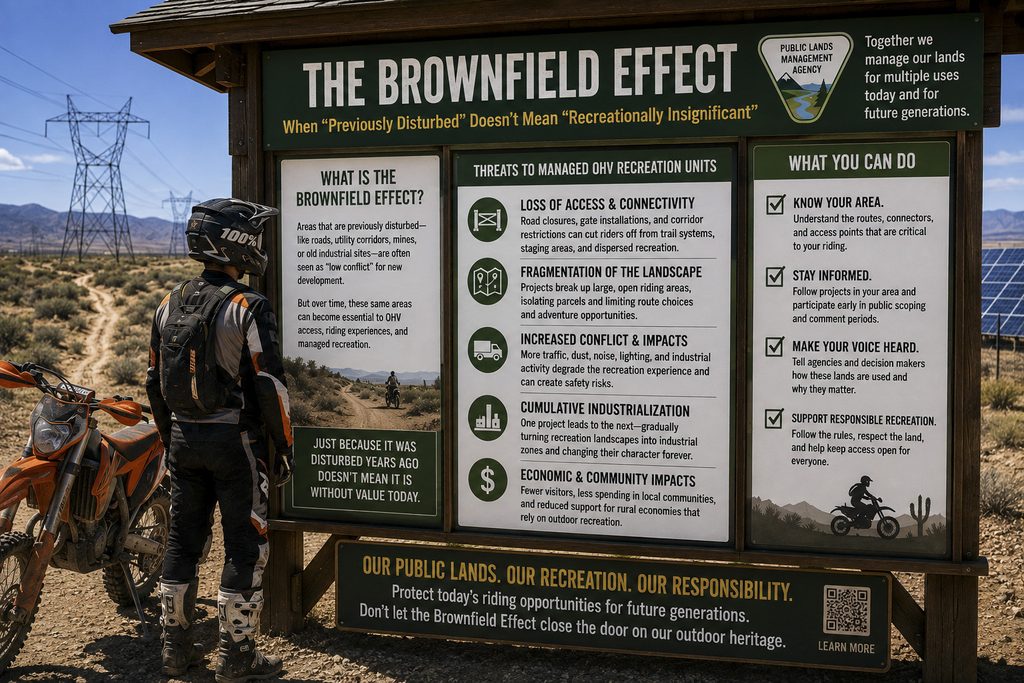
- The Brownfield Effect: Why OHV Clubs Need to Pay Attention: A Perspective for AARA Member Clubs and Recreation Stakeholders Most OHV riders would rather ride than read a 500-page environmental document. But major energy, transmission, mining, and infrastructure projects are increasingly proposed in and around the places where we ride. Understanding how these projects can affect access and recreation is increasingly important.
September 2026
The Brownfield Effect: Why OHV Clubs Need to Pay Attention: A Perspective for AARA Member Clubs and Recreation Stakeholders
Part of this issue is the Brownfield Effect: “previously disturbed” does not necessarily mean “recreationally insignificant.” Developers understandably look for existing roads, utility corridors, mine sites and other disturbed areas as potential project locations. Using those areas can reduce new environmental disturbance. The problem is that the same roads and corridors may have become important OHV access routes, connectors, staging areas or dispersed recreation infrastructure.
A project planner may see an existing road. An OHV rider may see the road that leads to the riding area. Both are looking at the same piece of ground.
The issue is becoming evident in several California projects, including the Coyote Creek Solar Project, the White Rock Mine proposal near Prairie City SVRA, the proposed Golden Pacific Powerlink in the Anza-Borrego landscape and the Ironwood Transmission Line Project in the BLM’s Imperial Sand Dunes Recreation Area. Although these projects differ, they raise a common question: what happens when industrial development moves into or around an established recreation landscape?
The Ironwood (California) project is a good example. The proposed approximately 86-mile, 500-kV transmission line would cross about eight miles of the BLM Imperial Sand Dunes Recreation Area and about 1.55 miles of Heber Dunes SVRA. The project would also require temporary and permanent access roads, staging areas and construction activities. The formal MIC, SVIA and ROHVA comments therefore request a route-by-route analysis of existing OHV routes, public access roads, connectors, staging and camping access, construction routes, and routes that could face future restrictions.
A recent Anza-Borrego Foundation report describes a related concept as an “Industrialization Cascade,” in which major infrastructure can make additional development easier, even though each project is reviewed separately. From an OHV perspective, this raises an important question: could today’s “previously disturbed” corridor become tomorrow’s justification for another industrial project? That is where the Industrialization Cascade and Brownfield Effect intersect.
This is why local OHV clubs matter. GIS maps and environmental databases are valuable, but they don’t always reflect how people actually use a landscape. Local riders know which routes connect riding areas, where people stage and camp, when peak use occurs, and which seemingly insignificant roads are important to the recreation network.
OHV clubs don’t need to become environmental lawyers. When a major project is proposed near your riding area, review the maps, identify the routes and connections, document seasonal and event use, and speak up while the project is still being designed. Once an environmental document is finalized, many fundamental project decisions may already be difficult to change.
This isn’t about opposing energy development. The OHV community needs reliable energy and responsible infrastructure. Previously disturbed lands are often suitable for new development. The point is simply that planners need to understand the existing public uses of those lands before assuming they are low-conflict locations.
For OHV clubs, the message is: know your ground, study the maps, get involved early, and help decision-makers understand how the recreation network actually works. The path of least resistance for a project isn’t necessarily the path of least impact on recreation.
Source note: This article incorporates key concerns regarding recreation access, connectivity, construction, visual impact, stakeholder engagement, and cumulative impact from the Sept. 16 MIC/SVIA/ROHVA Ironwood scoping comments.
For more AARA information visit: AARA